Blues & Greens Seamless Digital Paper: A Designer's Toolkit
There’s a particular kind of magic in a color palette that feels both calming and invigorating. Blues and greens together evoke natural landscapes—think of a forest meeting the sky, or the subtle gradients of a lagoon. This isn't just a color scheme; it's a mood. When you need that mood to be consistent, versatile, and ready to deploy, a high-quality Blues & Greens Seamless Digital Paper collection becomes an indispensable design asset. It’s more than just a background; it’s a foundational element that sets the tone for your entire project.
The Anatomy of a Seamless Pattern
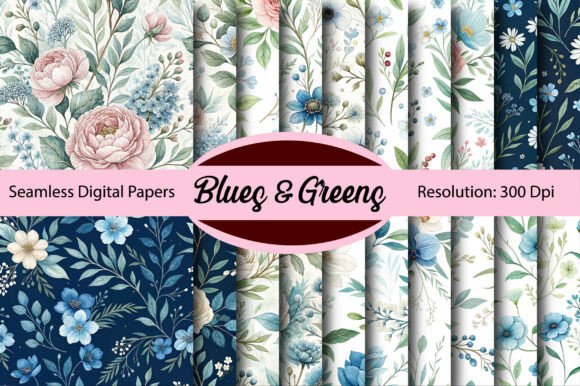
So, what exactly are we talking about? This isn't a single, static image. A seamless digital paper is a tile or a repeating graphic designed so that its edges align perfectly in every direction. When you tile it, there are no visible seams, creating a continuous, unbroken pattern. The "Blues & Greens" aspect refers to a curated range of color palettes within this category—perhaps a deep navy paired with a muted sage, or a vibrant teal fading into a soft seafoam. The personality is inherently versatile. It can feel professional and corporate with the right shade of blue, or organic and eco-friendly with certain greens. The overall appeal lies in its ability to provide texture and depth without overwhelming the main content of your design.
Resolution is key for practical use. A 300 dpi specification means these are premium font and design asset companions, built for print clarity. The seamless transparent pattern format (often provided in JPEG) allows the pattern to sit behind other elements, with transparency enabling layering over solid colors or other graphics for complex compositions.
Where This Palette Truly Shines
The applications for a well-executed Blues & Greens Seamless Digital Paper are vast, stretching across nearly every creative discipline. Its strength is in its ability to adapt to context.
- Branding & Marketing: For businesses in wellness, finance, technology, or environmental services, these papers offer a subtle yet impactful way to reinforce brand identity. Use them as social media graphics backgrounds, in email newsletter headers, or on presentation slide decks to maintain visual consistency. They work exceptionally well for packaging design, especially for products that want to convey freshness, trust, or innovation.
- Publishing & Editorial Design: In editorial design, these patterns can serve as chapter title page backgrounds, section dividers in magazines, or subtle texture for book covers. For bloggers and content creators, they make excellent Blog backgrounds that are easy on the eyes and won't distract from the written word, or can be used to create cohesive featured images.
- Digital & Web Design: As web design elements, they can be used for hero section backgrounds, footer patterns, or as texture behind call-to-action buttons. The seamless nature ensures they load quickly and display perfectly on any screen size. They are also ideal for creating unique digital wallpapers or device skins.
- Crafts & Print Projects: This is where the physical application comes to life. Use them for Scrapbooking Backgrounds, papercraft, DIY party packs, custom greeting cards, or even as a pattern for fashion projects like fabric printing. The 300 dpi quality ensures crisp printing on everything from photo paper to cardstock.
Integrating the Pattern: Practical Guidance
Simply having a beautiful pattern isn't enough. Effective integration requires a designer's eye for context and hierarchy. Here’s how to make the most of your Blues & Greens Seamless Digital Paper.
Evaluating Fit and Pairing
First, consider the project's personality. A busy, multi-colored geometric pattern in blues and greens might energize a youth-focused brand but could feel chaotic for a law firm's annual report. A subtle, watercolor-style wash might be perfect for a wedding invitation but too soft for a tech startup's logo design. Always test the pattern at the intended scale. What looks like a delicate texture in a thumbnail might become visually dominant when tiled across a full-page background.
Font pairing is critical. The pattern is the stage; the typography is the actor. For a pattern with fine, intricate details, pair it with clean, bold sans serif fonts for maximum readability and contrast. A simpler, more organic pattern can handle more expressive typefaces, like a refined script font for elegant invitations or a sturdy serif font for traditional publishing. Always check the contrast between your text color and the pattern. You may need to place a semi-transparent overlay or a solid text box on top of the pattern to ensure your message is legible.
Leveraging Format and Licensing
Understand what you’re getting. A collection that includes variations—different pattern scales, color intensities, and perhaps complementary solid color swatches—offers more flexibility. Review the included styles: is it just one repeating tile, or are there multiple coordinating patterns? This variety is what turns a single asset into a true toolkit.
For any commercial project—whether you're a small business owner designing your own packaging or a marketer creating client assets—clarify the commercial font and asset licensing. Most reputable providers offer clear licenses for both personal and commercial use, but it's your responsibility to ensure your intended use is covered, especially for products for sale or large-scale distribution.
The Subtle Power of Background
Never underestimate the role of a background. The right Blues & Greens Seamless Digital Paper does more than fill space. It influences mood, supports visual hierarchy by providing a non-competing texture, and enhances brand perception through consistent, professional application. It’s a workhorse asset that, when chosen and applied thoughtfully, elevates the entire design ecosystem you're building. It’s the quiet foundation that lets your primary message, your creative font choice, and your core imagery speak with clarity and impact.